Welcome to INDYGREEN TECHNOLOGIES


Giga Factories
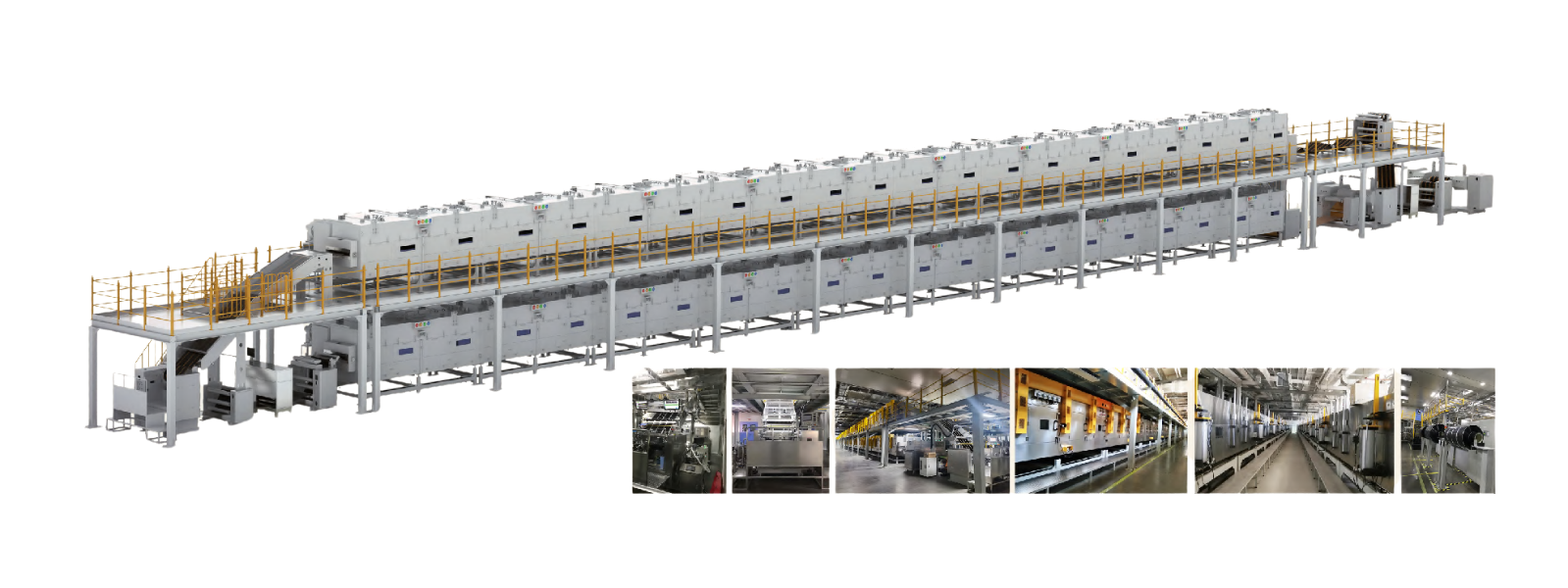
Typical Production Flow for 1 GWh LFP Cell Line
Raw Material Preparation
- Cathode Material: LFP powder (LiFePO₄) mixed with conductive carbon and binder.
- Anode Material: Graphite (natural or synthetic) mixed with binder
- Slurry Mixing: High-speed mixers create uniform cathode and anode slurries.
Electrode Manufacturing
- Coating: Slurries coated on aluminum (cathode) and copper (anode) foils.
- Drying: Continuous drying ovens remove solvents.
- Calendering: Rolls compress coated foils for uniform density and thickness.
- Slitting: Electrodes cut into precise widths for stacking or winding.
Cell Assembly
- Stacking / Winding: LFP cells can be prismatic or cylindrical, depending on design.
- Electrolyte Filling: Cells filled with LiPF₆-based electrolyte.
- Sealing: Pouch or prismatic cans sealed in controlled dry room conditions.
Formation & Aging
- Formation: Controlled charge-discharge cycles activate electrodes and form SEI layer.
- Aging: Cells rest for stability and performance verification.
- Testing & Grading: Cells sorted by voltage, capacity, and impedance.
Packing & Traceability
- PCells packed in vacuum-sealed trays under inert atmosphere.
- Data logged into MES (Manufacturing Execution System) for traceability.
Key Specifications for 1 GWh LFP Line
| Parameter | Specification |
|---|---|
| Annual Output | 1 GWh (~20 million 50 Ah cells) |
| Chemistry | Lithium Iron Phosphate (LiFePO₄) |
| Cell Format | Prismatic / Pouch |
| Production Area | ~20,000–25,000 m² (cleanroom zones) |
| Automation Level | Semi or fully automated line |
| Power Consumption | ~15–20 MW installed capacity |
| Workforce | 200–300 (operators + engineers) |
| Dry Room Humidity | < 1% RH (dew point −40°C) |
Copyright © 2012 INDYGREEN TECHNOLOGIES | All Rights Reserved.
 Get a Quote